Asclepius Meditec's 85th Paper Published... New Hydrogen-Oxygen Intervention Therapy for Silicosis, the "Most Prevalent Occupational Disease"!
According to media reports,Mr.Chen,65,who often worked in a dusty environment,was sent to the emergency room after an accidental fall.An X-ray examination revealed suspicious small white spots and pulmonary effusion in his lungs,ultimately leading to a diagnosis of"silicosis."Currently,there is no effective cure,and treatment mainly focuses on symptom management,such as administering cough suppressants,pain relievers,and other medications.
(Mr.Chen's X-ray)
Silicosis,also known as silicon pneumoconiosis,is the most common type of pneumoconiosis.It is caused by long-term inhalation of large amounts of free silica dust and is characterized by extensive nodular fibrosis in the lungs.Silicosis is the most common,fastest-progressing,and most severe type of pneumoconiosis[1].According to statistics,there are nearly 30,000 new cases of silicosis in China each year,accounting for 90%of new occupational diseases,making it the undisputed"most common occupational disease"!Due to the lack of targeted therapeutic drugs,the prognosis is often poor.Lung transplantation is an expensive intervention[2].Lung lavage lacks efficacy in prolonging patient survival[3].There is an urgent need for new treatment methods.Recently,researchers from Shandong First Medical University and the Shandong Institute of Occupational Health and Occupational Disease Prevention and Treatment conducted a study titled"An Experimental Study on the Improvement of Silicosis in Animals by Hydrogen-Oxygen Gas+Tetrandrine"and successfully published their findings in International Immunopharmacology[4].
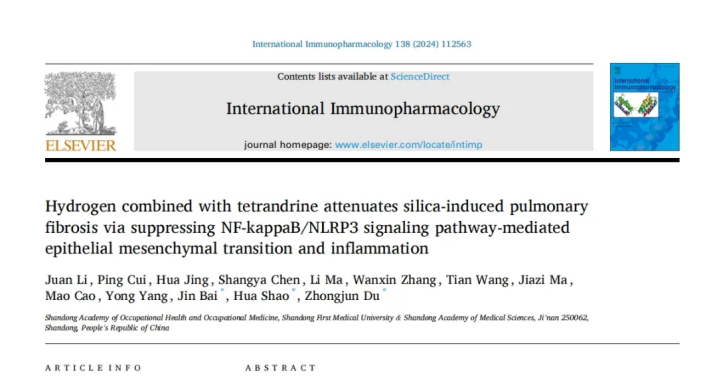
(Screenshot of the paper)
Hydrogen molecules possess characteristics such as antioxidant and anti-inflammatory properties,offering potential therapeutic effects for many inflammation-related diseases.Previously,there were no experimental studies on the effectiveness of hydrogen in treating silicosis.This is also the first experimental research paper on the use of hydrogen-oxygen gas to ameliorate silicosis,providing important evidence for future human trials!
Hydrogen-Oxygen vs.SilicosisIn the study"An Experimental Study on the Improvement of Silicosis in Animals by Hydrogen-Oxygen Gas+Tetrandrine,"researchers administered combined intervention of hydrogen-oxygen and tetrandrine to animal models of silicosis.Through histopathology,oxidative stress,and pulmonary fibrosis levels,it was demonstrated that the combined treatment of hydrogen-oxygen and tetrandrine(synergistic effect)effectively alleviated pulmonary fibrosis in silicotic animals.Indicators such as lung function,inflammation,and oxidative stress also showed corresponding positive changes.
Experimental ProcessExperimental rats were randomly divided into five groups(n=10 per group)at three time points using a random number table method:Control group(Control),Silicosis model group(Model),Tetrandrine intervention group(Tet),Hydrogen-oxygen intervention group(H2),and Hydrogen-oxygen combined with Tetrandrine intervention group(Tet+H2).
In the experiment,the hydrogen-oxygen mixed gas(66%hydrogen;33%oxygen)was delivered via nasal cannula at a rate of 3 L/min using the Asclepius Hydrogen-Oxygen Inhaler AMS-H-03(National Medical Device Registration No.20203080066).
Rats were exposed to silica dust.The Control group received intratracheal instillation of 1 ml of normal saline,while the Model group received intratracheal instillation of 1 ml of silica dust suspension(50 mg/ml)under mild isoflurane anesthesia.Intervention began on the second day after modeling:rats in the Tetrandrine intervention group received daily intragastric administration of Tetrandrine at 30 mg/kg,and rats in the Hydrogen-oxygen intervention group received continuous inhalation of hydrogen-oxygen gas for 4 hours daily.Serum and lung tissue samples were collected for analysis on the 14th,28th,and 56th days post-intervention.
Experimental ResultsExperimental Result 1:Hydrogen-Oxygen Gas Combined with Tetrandrine Alleviates Silica Dust-Induced Pulmonary Fibrosis
After exposure to dust,rats gradually exhibited an increase in pulmonary fibrosis,characterized by the accumulation of fibrous tissue and collagen,which peaked on the 56th day.Compared with the Model group,the intervention with hydrogen-oxygen gas combined with tetrandrine resulted in a significant reduction in fibrosis,with the most pronounced effect observed on the 56th day as the intervention duration increased(Figure 2A-C).
(A)Representative images of Masson staining of lung tissue sections(200×),scale bar=200μm.
(B)Pulmonary fibrosis score.
(C)Collagen volume fraction.
Experimental Result 2:Hydrogen-Oxygen Combined with Tetrandrine Alleviates Silica Dust-Induced Lung InjuryHE-stained pathological sections of lung tissue were examined to assess alveolar structure and inflammatory infiltration(Figure 3A and B).Compared with the Control group,rats exposed to SiO2 particles for 14 days exhibited significant inflammatory infiltration.By day 28,inflammatory cells increased,and nodules appeared in the lungs of the rats.By day 56,the alveolar structure of the rat lung tissue was significantly altered,with an increase in nodules.Compared with the Model group,all three intervention groups showed a reduction in alveolar structural abnormalities and inflammatory infiltration.
(A)Representative images of HE-stained lung tissue sections(200×),scale bar=200μm.
(B)Changes in alveolar inflammation scores.
(C)Lung coefficient.
DiscussionSilicosis is an incurable occupational lung disease caused by inhalation of crystalline SiO2 particles.It is progressive,irreversible,and can lead to disability.The intervention combining hydrogen-oxygen mixture with tetrandrine can reduce pulmonary inflammation and oxidative stress,inhibit the EMT(Epithelial-mesenchymal transition)process,and improve silicotic fibrosis.The results of this study show that compared to the pathological sections of the model group,all three intervention groups exhibited reduced inflammatory infiltration,suppressed fibrous tissue hyperplasia,and effectively decreased the degree of fibrosis.In summary,through pathological observation,inflammatory factor detection,and protein expression verification,this study confirmed that hydrogen-oxygen gas combined with tetrandrine can reduce inflammatory response and oxidative stress,inhibit the EMT process,and improve silicosis fibrosis via the NF-κB/NLRP3 signaling pathway.
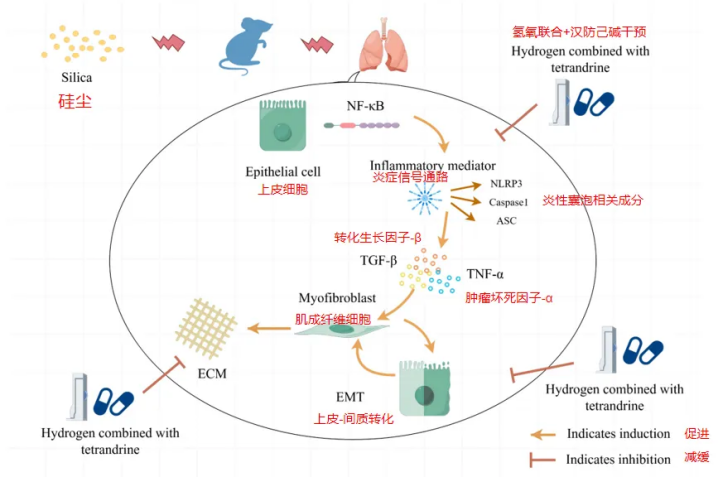
(Figure 1 Schematic diagram of hydrogen-oxygen combined with tetrandrine attenuating silicosis fibrosis)
Finally,whether using"hydrogen-oxygen inhalation"alone or"hydrogen combined with tetrandrine"to address pulmonary fibrosis,this intervention effectively alleviated oxidative stress,reduced lung inflammation,inhibited the EMT process,and improved silicosis fibrosis.We look forward to more clinical studies or real-world observations to show a hopeful blue sky for patients with pulmonary fibrosis!
References:[1]Silicosis.https://www.cnjx.gov.cn/OpennessContent/show/2596226.html[2022-12-13][2]S.Krefft,J.Wolff,C.Rose,Silicosis:an update and guide for clinician,Clin.Chest Med.41(4)(2020)709–722.[3]J.Pang,X.Qi,Y.Luo,et al.,Multi-omics study of silicosis reveals the potential therapeutic targets PGD(2)and TXA(2),Theranostics 11(5)(2021)2381–2394.[4]Li J,et al.Hydrogen combined with tetrandrine attenuates silica-induced pulmonary fibrosis via suppressing NF-kappaB/NLRP3 signaling pathway-mediated epithelial mesenchymal transition and inflammation.Int Immunopharmacol.2024 Jun 28;138:112563.


